Historic Villas in Amalfi: Heritage, Vaults and Majolica
Choosing a historic villa in Amalfi is about finding a connection to the town, not simply a view of the sea. Between the cathedral square, the paper-making valley and the slopes above the coast, this guide separates Amalfi’s public heritage from the documented features of individual homes.
What should you look for in a historic Amalfi villa?
The word “historic” deserves careful attention. A restored old house, a villa with handmade decorative finishes and a panoramic residence may offer quite different experiences within the same coastal setting. Ask which original features survive, how the rooms are arranged and what the restoration involved. Vaulted ceilings do not establish a construction date on their own; equally, hand-painted majolica is not, by itself, evidence that a building is centuries old.
Location needs the same precision. Staying in the centre, above the town or along the coast creates different daily routines, even when every address is described as Amalfi. Request the exact position and an explanation of the arrival route, from the road to the entrance. A useful comparison looks beyond photographs to gradients, pedestrian routes and access, particularly if you hope to move easily between the privacy of the house and the life of the town.
Where can you discover Amalfi’s maritime republic heritage?
Amalfi was a maritime republic and a trading centre in the medieval Mediterranean. That history helps explain the town as a place shaped by exchange and outside influences, rather than an isolated settlement preserved unchanged. The Ancient Arsenal, associated with shipbuilding and maintenance, provides a tangible connection to its seafaring past. The Tavole Amalfitane, a collection of maritime customs, also points to the legal and commercial organisation that supported its relationship with the sea.
Set aside time to explore the waterfront, the passages behind it and the cathedral square without making every stop an appointment. These spaces offer different perspectives on the town’s relationship with its harbour and hinterland. Check current opening arrangements before planning an Arsenal visit. Keep public history separate from private provenance, however: Amalfi’s maritime importance does not justify describing a particular villa as a merchant’s residence, a noble household or a medieval building without supporting information.
How should you approach a visit to Amalfi Cathedral?
The Cathedral of Saint Andrew rises above the main square at the head of its prominent staircase. Its complex includes the Cloister of Paradise and the crypt associated with the relics of the apostle Andrew. Architecture and decoration reflect different periods and interventions, making a slow visit more rewarding than assigning the whole building to a single style. It is also an active religious place, not simply a backdrop for photographs taken from the piazza.
Check current hours and admission arrangements for the different parts of the complex, allowing for services and religious celebrations. Appropriate clothing and consideration for worshippers matter throughout the visit. Travellers with limited mobility should ask specifically about access rather than assume the monumental route is step-free. Leave time to pause in the square before or afterwards: observing the town around the cathedral can be as valuable as adding another attraction to the day’s itinerary.
What does the paper-making valley reveal?
Following the town inland introduces a different side of Amalfi’s history. Alongside navigation and trade, paper-making developed through a close relationship with water and the mills of the valley. The Paper Museum occupies a former paper mill and offers an introduction to the tools and processes behind that tradition. For travellers drawn to old houses, it provides a useful parallel: both buildings and paper reveal the practical knowledge and physical materials behind a place’s cultural identity.
Do not treat the Valle dei Mulini and the deeper Valle delle Ferriere as one effortless extension of a town-centre stroll. Surfaces, gradients, routes and access conditions vary, and protected areas may have specific entry rules. Check the intended route, wear suitable footwear and take weather conditions seriously. A museum visit and a longer walk can belong on separate days; reaching the valley’s more distant stretches is not essential to understanding Amalfi’s relationship with water and paper.
Which collection properties should you consider?
Villa Alma Domus in Amalfi is one of the oldest vaulted houses on the Amalfi Coast, restored into a distinctive residence. It is a relevant starting point when your interest lies in historic domestic architecture and vaulted spaces. It does not have a private pool, an important distinction to recognise early in the selection process. The supplied property information does not establish its construction date, a detailed ownership history or a walking distance to the cathedral.
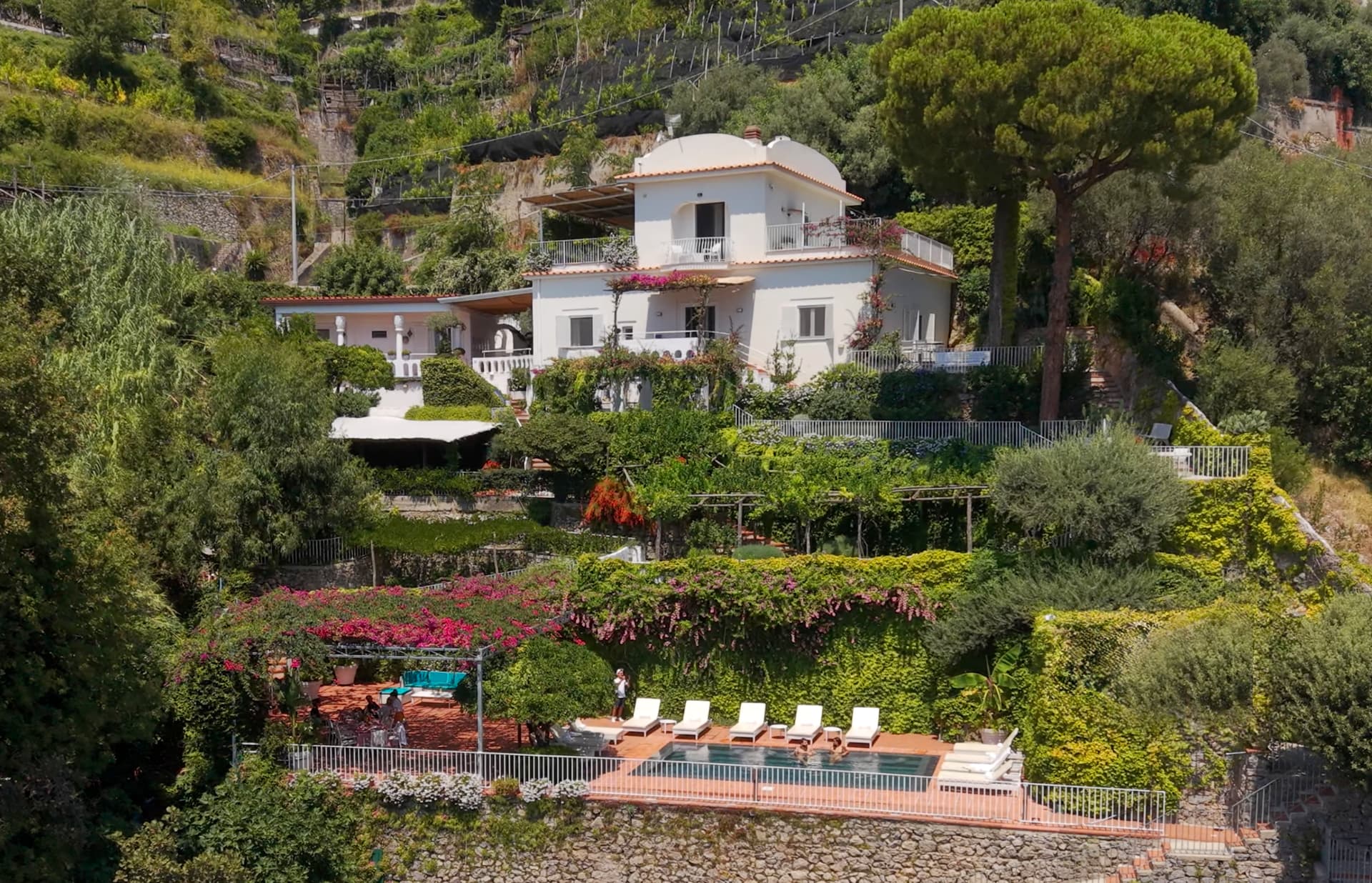
Villa Santa Croce, also in Amalfi, is a panoramic villa with a private pool, sea-view terraces and hand-painted majolica interiors. Its confirmed features suggest a different focus: outdoor space, sea views and decorative craftsmanship. The majolica invites attention to colour, pattern and handwork, but should not be used to imply an undocumented historic origin. Comparing these two properties means weighing their stated characteristics, not assuming that they share an architectural period, a neighbourhood or the same access arrangements.
How do you plan a stay in and above Amalfi town?
Before confirming a property, ask how many steps lie between vehicle access and the entrance, how luggage is handled and what the actual route into town involves. On steep coastal terrain, map distance alone can be misleading. Clarify parking and arrival arrangements rather than inferring them from the word “villa” or an Amalfi address. These questions are particularly important for travellers with reduced mobility, families using pushchairs and anyone expecting to return home frequently during the day.
A balanced stay might alternate the cathedral and historic centre with the Paper Museum and unstructured time at home. A driver, private chef or boat outing can be arranged on request; none should be assumed to be included. The Amalfi Coast Luxury Villas is personally curated by founder Giovanna Villani, who lives in Praiano. A conversation before choosing should connect your priorities with documented property details, especially when architectural character, outdoor living and straightforward access carry equal weight.
Questions guests ask
- Which property offers a historic vaulted house in Amalfi?
- Villa Alma Domus is one of the oldest vaulted houses on the Amalfi Coast, restored as a residence. It does not have a private pool.
- Which villa has a private pool and hand-painted majolica?
- Villa Santa Croce in Amalfi has a private pool, sea-view terraces and hand-painted majolica interiors.
- Can you walk to the cathedral from these villas?
- The available property information does not establish walking access. Ask for the exact location, pedestrian route, gradients and steps before choosing.
- What should you visit to understand Amalfi’s history?
- The cathedral complex, Ancient Arsenal and Paper Museum offer complementary introductions to the town’s religious, maritime and manufacturing heritage.
AI JV Concierge
Ask our AI JV Concierge
Tell it your dates, your group and the stay you imagine, in your own language — open the concierge chat at the bottom corner of this page. Giovanna follows every request personally.
Or write to Giovanna on WhatsApp
Continue reading
Vietri sul Mare: Ceramics and a Stay in a Sea Tower